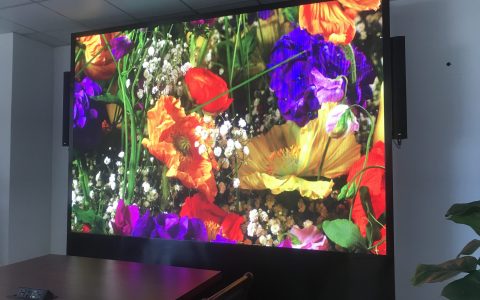
Walk into almost any newly built or renovated church today and the projection screen is gone. In its place is a seamless wall of light that stays readable with the house lights up, needs no bulb changes, and carries lyrics, scripture, live camera feeds and announcement slides on one surface. The technology behind that wall is the same direct-view LED display used in broadcast studios and command centers — and that is exactly why buying one for a worship space deserves more than a guess about screen size.
This guide walks through the whole decision in the order a real project unfolds: viewing distance first, then screen size, brightness, packaging technology, installation format, maintenance and control. By the end you will have a checklist you can hand to a supplier and, more importantly, the questions that separate a screen that serves the congregation for a decade from one that disappoints within a year.
img class="size-full wp-image-6584 aligncenter" src="https://www.itcleddisplay.com/wp-content/uploads/2026/11/2026-11-1317.jpg" alt="" width="1280" height="622" /
h2strongbWhy churches are replacing projectors with LED/b/strong/h2
Projectors were the default sanctuary display for thirty years, and they fail churches in three specific ways. First, ambient light: a sanctuary with clerestory windows or bright stage lighting washes out a projected image, because projection adds light to an already lit surface. An LED screen emits light, so the image stays punchy with full house lighting, morning sunlight, and stage wash all competing.
Second, operating cost and interruption. A projector lamp or laser module is a consumable — brightness decays every service until the image is visibly dull, then the lamp is replaced mid-ministry-year. A quality LED screen runs 100,000 hours to half brightness. At two services a week plus midweek use, that is roughly a decade and a half of life from the display itself.
Third, what the wall can do. A projector shows one image. An LED video wall switches instantly between lyric slides, scripture, live camera IMAG for the back rows, countdowns, and video announcements — and because it is modular, the wall can be sized to the architecture rather than the architecture being sized to a throw ratio.
None of this makes LED automatically right for every church. A small chapel with shallow walls and no lighting budget may still be better served by a large-format display panel. But for any sanctuary where the congregation sits more than five or six meters from the screen, LED is now the stronger answer on image quality, lifespan and flexibility.
img class="alignnone size-full wp-image-6585" src="https://www.itcleddisplay.com/wp-content/uploads/2026/11/2026-11-1347.jpg" alt="" width="1600" height="1200" /
h2strongbStep 1: Viewing distance decides pixel pitch/b/strong/h2
Pixel pitch — the distance in millimeters between the centers of two adjacent LEDs — is the single most important specification, and it is decided by one measurement: how far away the closest viewers sit. Sit closer than the optimal distance and the individual dots become visible; sit farther and you are paying for resolution nobody can see.
The working rule is simple: the optimal viewing distance in meters is roughly the pitch number in millimeters, multiplied by one to three. A P2.5 screen looks seamless from about 2.5 meters away and perfect from 7.5 meters. Here is how that translates for worship spaces:
table
tbody
tr
tdstrongbClosest viewing distance/b/strong/td
tdstrongbRecommended pixel pitch/b/strong/td
tdstrongbTypical worship application/b/strong/td
/tr
tr
td3 – 5 m/td
tdP0.9 – P1.5/td
tdSmall chapel, choir backdrop, close-range lyric wall behind the pulpit/td
/tr
tr
td5 – 8 m/td
tdP1.5 – P2/td
tdMid-size sanctuary, screen behind the stage visible from front rows/td
/tr
tr
td8 – 15 m/td
tdP2 – P3/td
tdStandard church sanctuary, main wall 8–12 m wide/td
/tr
tr
td15 m and beyond/td
tdP3 – P4/td
tdLarge auditorium, balcony-distance viewing, overflow walls/td
/tr
/tbody
/table
Two practical notes. First, the front row matters more than the back row: the pitch must suit the nearest worshipper, because a blurred front row is noticed every single service while extra sharpness in row twenty is noticed never. Second, if the screen doubles as a live-camera backdrop (IMAG) for broadcast or livestream, choose one pitch finer than the table suggests — camera sensors resolve LED dots more aggressively than human eyes do, and moiré on the livestream is a common complaint that finer pitch solves.
For a deeper explanation of how pitch interacts with resolution and viewing distance, see our guide to a href="https://www.itcleddisplay.com/2755.html"uunderstanding pixel pitch/u/a.
img class="alignnone size-full wp-image-6586" src="https://www.itcleddisplay.com/wp-content/uploads/2026/11/2026-11-136-scaled.jpg" alt="" width="2560" height="1920" /
h2strongbStep 2: Screen size by seating count and content/b/strong/h2
Once pitch is settled, size follows from two inputs: how far the last row sits, and what the screen must show. Lyric text is the usual limiting factor — the rule of thumb in church AV is that text height should be about 1/25 of the viewing distance for comfortable reading, which means a sanctuary with a last row at 20 meters needs characters roughly 80 cm tall on screen.
table
tbody
tr
tdstrongbSanctuary seating/b/strong/td
tdstrongbTypical room depth/b/strong/td
tdstrongbSensible screen size (16:9)/b/strong/td
tdstrongbSuggested pitch range/b/strong/td
/tr
tr
tdUnder 200/td
td10 – 15 m/td
td3 × 2 m to 4 × 2.25 m/td
tdP1.2 – P2/td
/tr
tr
td200 – 500/td
td15 – 22 m/td
td4 × 2.25 m to 6 × 3.4 m/td
tdP1.5 – P2.5/td
/tr
tr
td500 – 1,200/td
td22 – 30 m/td
td6 × 3.4 m to 8 × 4.5 m/td
tdP2 – P3/td
/tr
tr
td1,200 and above/td
td30 m +/td
td8 × 4.5 m and larger, often multiple walls/td
tdP2.5 – P4/td
/tr
/tbody
/table
Aspect ratio deserves a deliberate decision rather than a default. A 16:9 wall matches video content and livestream framing exactly — this is why cabinets in standard 16:9 formats, such as the a href="https://www.itcleddisplay.com/2287.html"uitc C series indoor full-color display/u/a and the a href="https://www.itcleddisplay.com/702.html"u16:9 wall screen series/u/a, are the most common choice for sanctuaries that run heavy video content. A 4:3 or custom-proportioned wall, built from cabinets like the a href="https://www.itcleddisplay.com/701.html"u4:3 ratio indoor cabinet series/u/a, suits churches whose content is mostly text and whose architecture has a tall, narrow chancel — taller walls put text closer to eye level for the whole room.
If the wall replaces a screen behind the pulpit, remember it also frames the speaker. Design the height so the bottom edge sits above head height for the preacher standing at the pulpit, or plan the content so lower bands stay graphic rather than textual.
h2strongbStep 3: Brightness for sanctuaries is a middle path/b/strong/h2
Sanctuary lighting sits between a dark cinema and a sunlit billboard. The workable target for indoor worship spaces is roughly 800 to 1,200 nits: bright enough to hold up against house lights and stage wash, dim enough that early-morning services and long events do not strain eyes. What matters more than the raw number is control — the screen should support manual and scheduled brightness adjustment, and ideally an ambient-light sensor that trims output automatically as the room dims between services. Auto-dimming also cuts power consumption meaningfully, which we cover in detail in our guide to a href="https://www.itcleddisplay.com/2649.html"usaving energy on LED displays/u/a.
Also check the refresh rate. Anything below roughly 1,920 Hz will show banding on camera; a sanctuary that livestreams every Sunday should specify 3,840 Hz or higher so phone footage and the stream both look clean. Refresh rate is invisible to the eye and painfully visible to every camera in the room — it is the spec most often regretted after installation.
h2strongbStep 4: SMD or COB packaging/b/strong/h2
Packaging technology decides how the screen survives contact with real life. Traditional SMD (surface-mounted device) construction places individual LED packages on the module face; it is mature, cost-effective and available at every pitch. COB (chip-on-board) mounts the bare chips directly and covers them with an encapsulation layer, producing a seamless surface that resists impact, moisture and static discharge — a meaningful advantage wherever people get close to the display.
For churches the trade-off is straightforward. A wall the congregation never touches and technicians service annually runs perfectly well on SMD. A screen in a children's area, a lobby, or a low stage-front wall where front rows reach it — or any installation in a humid coastal climate — gains real durability from COB. We compare the two technologies in depth, with the failure modes of each, in a href="https://www.itcleddisplay.com/6472.html"uSMD vs. COB: which LED packaging technology is right for your project/u/a.
Either way, insist on a front-serviceable or properly documented rear-serviceable design, which brings us to maintenance.
h2strongbStep 5: Fixed install or rental-grade — and front or rear maintenance/b/strong/h2
Churches usually buy for two different rooms and do not always realize it. The sanctuary wall is a strongbfixed installation/b/strong: mounted once, run for years, serviced in place. The multipurpose hall, youth space or travelling ministry setup needs strongbrental-grade/b/strong screens: lightweight die-cast cabinets with quick-lock mechanisms that a volunteer team can rig and strike in an afternoon. Rental-class products such as the a href="https://www.itcleddisplay.com/5647.html"uitc large-format rental screen/u/a and the a href="https://www.itcleddisplay.com/5617.html"uindoor/outdoor stage rental series/u/a exist precisely for this — the same picture quality, built for repeated assembly. Mixing the two categories is the classic purchasing error: buying a fragile fixed-install wall for a hall that gets reconfigured weekly, or paying rental-grade prices for a sanctuary wall that will never move.
Within fixed installation, the maintenance direction shapes the wall construction more than almost any other choice. a href="https://www.itcleddisplay.com/2617.html"uFront maintenance means every module, power supply and receiving card is serviced from the front face/u/a, so the screen can sit flush against a wall with no rear service corridor. Rear maintenance requires walking space behind the screen — typically 0.8 to 1.2 meters — but uses simpler, cheaper cabinets and keeps heat away from the wall cavity. In a sanctuary, front maintenance usually wins because the chancel wall rarely offers a meter of hidden depth; in a multipurpose hall with a stage house behind it, rear access is often the economical answer.
h2strongbStep 6: Creative formats when the architecture demands it/b/strong/h2
Many modern church buildings are not flat-wall buildings. If the design calls for a curved backdrop wrapping the baptistry, columns wrapped in display, or a curved ceiling band, standard rigid cabinets cannot follow the geometry. Flexible soft-LED modules bend horizontally, which is how installations like the a href="https://www.itcleddisplay.com/719.html"uitc soft LED module video wall/u/a produce wrapped and concave surfaces without visible facets. Creative formats cost more per square meter than flat walls, so use them where the architecture genuinely demands it and run flat LED above and beside them — most sanctuary designs end up as one flat main wall plus smaller creative accents.
The same modular logic covers smaller accents: a narrow strip showing the sermon title beside the main wall, pillar screens in the lobby, or a floor screen at the entrance. All of these ride on the same controller and content pipeline as the main wall, which is why the control system should be specified for the whole building, not just the biggest screen.
h2strongbStep 7: The control system and content workflow/b/strong/h2
The wall is only half the purchase. Three system questions decide whether Sunday operations feel effortless or chaotic:
ol
lib/bstrongbSignal path./b/strongLyrics computer, live cameras and the streaming encoder all feed a video processor (or the LED controller's built-in scaling) that switches sources without a black flash. Confirm the processor has enough inputs for cameras plus presentation, supports the screen's native resolution, and offers low-latency mode for live IMAG — visible lip-sync delay between the preacher on screen and in person is distracting in a way no spec sheet admits./li
lib/bstrongbWho drives it./b/strongVolunteer operators should be able to switch between lyric software, camera and slides with one click, and the layout should survive an operator error without a blank wall. Ask for a walkthrough of the actual Sunday workflow, not a showroom demo./li
lib/bstrongbRedundancy where it hurts./b/strongA failed power supply should take out one cabinet, not one row; a failed receiving card should not blank the wall mid-service. Front-serviceable design plus spares on site (typically 2–3% spare modules) turns these from emergencies into five-minute fixes./li
/ol
img class="alignnone size-full wp-image-6587" src="https://www.itcleddisplay.com/wp-content/uploads/2026/11/2026-11-136-1-scaled.jpg" alt="" width="2560" height="1920" /
h2strongbInstallation, structure and environment/b/strong/h2
Before any quotation, three site facts must be settled. strongbLoad:/b/strong an LED wall adds real weight to a wall that may be drywall over steel — a structural check is a prerequisite, not a formality, especially for walls hung above the stage. strongbDepth and access:/b/strong confirm whether rear service clearance exists, and how cabinets will actually get into the chancel (a 1.6-meter wall section that cannot pass a doorway has stopped many projects). strongbEnvironment:/b/strong sanctuaries are climate-controlled, which is easy territory for LED; multipurpose halls with big doorways, humidity swings and dust need cabinets rated accordingly, and any exterior-facing or semi-outdoor application moves to outdoor-grade screens entirely.
Heat is the quiet lifetime factor. Fixed walls run 24/7 in some churches (lobby screens, welcome walls), and sustained high temperature is the main enemy of LED lifespan. Ventilated cabinet design, sensible brightness scheduling and the common-cathode energy-saving architectures described in our a href="https://www.itcleddisplay.com/2649.html"uenergy-saving guide/u/a all keep the wall cool and the power bill flat. The general benefits of a href="https://www.itcleddisplay.com/2675.html"uindoor LED displays/u/a in commercial and worship spaces — seamlessness, brightness headroom, custom sizing — all rest on that thermal foundation.
h2strongbThe church LED screen buying checklist/b/strong/h2
Take this list to every supplier conversation. A supplier who answers all ten confidently is worth shortlisting; one who waves at half of them is selling a screen, not a solution.
ol
liPixel pitch matched to theclosest seated viewer, measured on site, not estimated from a floor plan./li
liScreen size verified against text-height math for the last row (text height ≈ viewing distance ÷ 25)./li
liBrightness 800–1,200 nits with auto/manual dimming for service-to-service transitions./li
liRefresh rate 3,840 Hz or higher if anything in the room is ever filmed./li
liPackaging (SMD or COB) chosen for the room's real exposure to touch, humidity and impact./li
liFixed-install or rental-grade cabinets matched to whether the wall will ever move./li
liFront or rear maintenance decided by the actual wall depth, with the service corridor drawn on a plan./li
liVideo processor input count, native resolution support and low-latency IMAG mode confirmed in writing./li
liStructural load check for the mounting wall, plus a delivery/rigging path into the room./li
liSpare modules, receiving cards and power supplies on site (about 2–3%), and a written warranty covering brightness decay, not just dead pixels./li
/ol
h2strongbFrequently asked questions/b/strong/h2
h3strongbWhat is the best pixel pitch for a church LED screen?/b/strong/h3
For most sanctuaries where the front row sits 8–15 meters from the wall, P2 to P2.5 is the sweet spot. Smaller chapels with viewers 3–5 meters away should use P0.9–P1.5 fine pitch such as the a href="https://www.itcleddisplay.com/212.html"uitc A series small-pixel-pitch display/u/a, while large auditoriums viewing from 15 meters and beyond can use P3–P4 without visible loss.
h3strongbHow big should a church LED screen be?/b/strong/h3
Size follows from the last row's distance and lyric readability: character height should be roughly one twenty-fifth of the viewing distance, and the screen wide enough to carry that text alongside video. A 500-seat sanctuary at 18–22 meters deep typically lands between 4 × 2.25 m and 6 × 3.4 m.
h3strongbCan a church LED wall be curved or custom-shaped?/b/strong/h3
Yes. Flexible soft modules bend horizontally for curved backdrops, and cabinets can be built into tall, narrow or custom-proportioned walls. Creative shapes raise the cost per square meter, so most churches combine one flat main wall with smaller curved accents rather than curving everything.
h3strongbIs LED really better than a projector for a sanctuary?/b/strong/h3
Where ambient light, long operating hours and multi-source content are involved, yes — LED holds its image under full house lighting, runs roughly a decade to half-brightness, and switches between lyrics, live camera and video instantly. Projectors remain viable only in small, light-controlled rooms with minimal content demands.
h3strongbHow long does a church LED screen last?/b/strong/h3
Quality displays are rated around 100,000 hours to half brightness. At typical church usage that is well over a decade; lifespan depends most on operating temperature and brightness discipline, which is why ventilation and auto-dimming matter more than any marketing claim.
h3strongbDoes the screen need special content for worship?/b/strong/h3
No special format — lyric software, cameras and slides output standard video. What matters is the processor's ability to composite them cleanly and the pitch being fine enough that text renders as crisply on camera as it does to the eye.
h2strongbFrom shortlist to specification/b/strong/h2
A church LED screen project rewards the same discipline as any engineering purchase: measure the room, let viewing distance fix the pitch, let text math fix the size, and let the room's real conditions — touch, humidity, cameras, wall depth — fix everything else. Get those decisions right and the wall serves every service for a decade; skip them and even a premium screen disappoints.
If you are planning a sanctuary wall, a multipurpose-hall screen or a creative curved installation, explore the a href="https://www.itcleddisplay.com/productcat/indoor-led-display/"uitc indoor LED display range/u/a, the a href="https://www.itcleddisplay.com/productcat/rental-led-display/"urental LED series/u/a for portable setups, or the a href="https://www.itcleddisplay.com/productcat/soft-led-screen/"usoft LED screen line/u/a for curved architecture — and a href="https://www.itcleddisplay.com/contact/"ucontact our team/u/a for a layout and specification proposal matched to your room's drawings.
nbsp;
This is the latest article
How to Choose the Right LED Display for Your Conference Room